
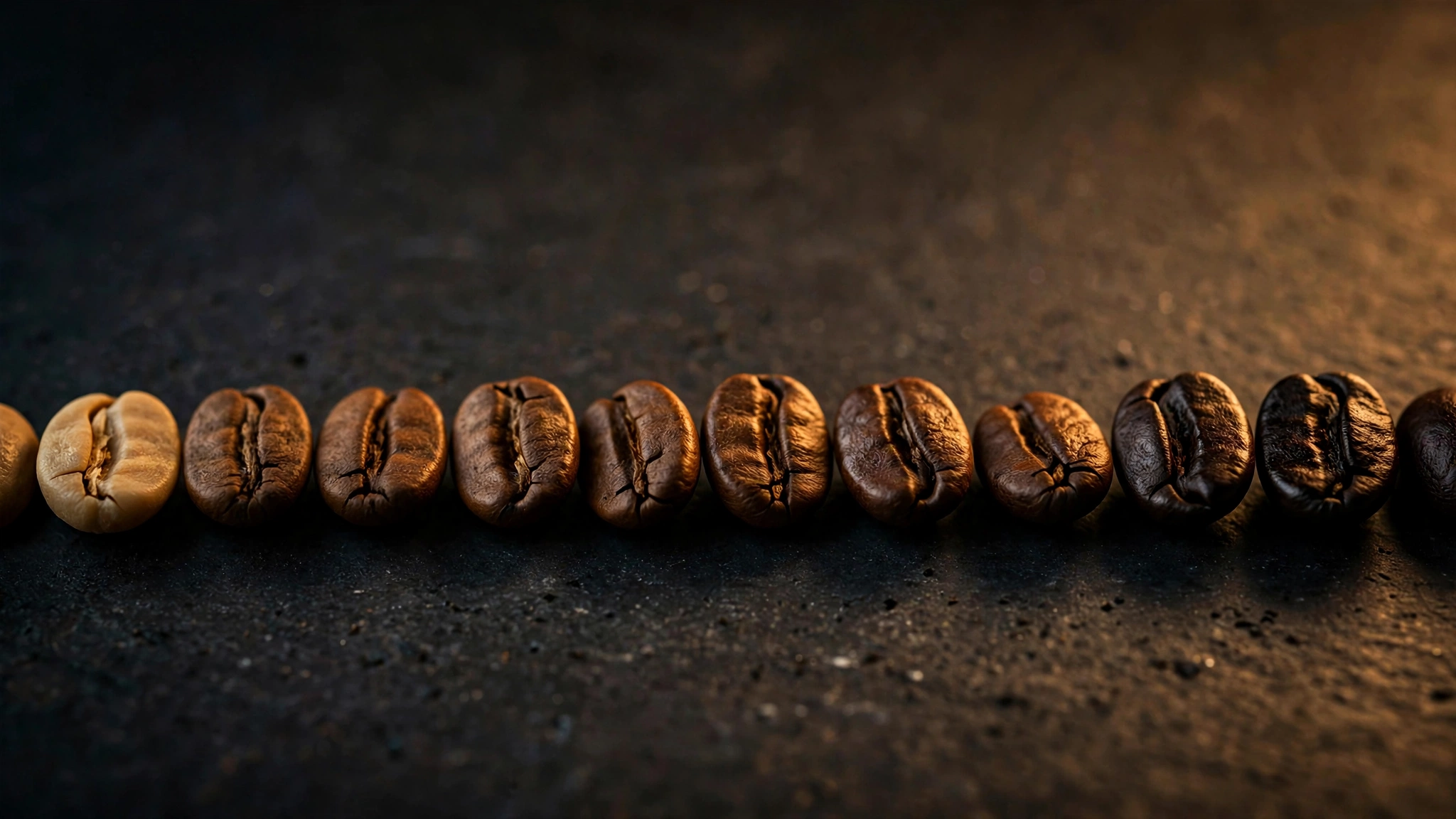
Roasting turns dense, grassy-smelling green seeds into the brittle, aromatic beans we grind and brew. Hundreds of chemical reactions take place in roughly ten to fifteen minutes, and the roaster's choices about heat and time decide whether a delicate coffee tastes floral or flat. Understanding what happens in the drum, and what the terms "light", "medium" and "dark" really mean, makes it easier to buy and brew with intention.
The journey from green to brown
Green coffee is typically about 10 to 12 percent water. During roasting, the beans lose a considerable share of their weight, commonly in the range of 12 to 20 percent, mostly through water loss and the escape of gases. The process is usually described in phases:
- Drying phase. Beans start as pale green and shed moisture, turning yellow and giving off a grassy, hay-like smell. Energy is being absorbed with little visible flavor development.
- Maillard and browning phase. As bean temperature climbs into the range of roughly 150°C (300°F) and above, Maillard reactions between amino acids and sugars begin producing the bready, toasty aromas and brown color. Sugars also begin caramelizing at higher temperatures.
- First crack. At somewhere around 195 to 205°C (385 to 400°F), pressure from steam and gases causes the beans to expand and audibly crack, a bit like popcorn. This is a key milestone: beyond it, the coffee is technically drinkable and the roaster moves into the "development" stage.
- Development. The time between first crack and the end of the roast is when sweetness, acidity and aromatic compounds are tuned. Many roasters track development time as a percentage of total roast time, often in the range of about 15 to 25 percent for filter-oriented profiles, though preferences and equipment vary widely.
- Second crack. At higher temperatures, often above 220°C (about 430°F), a second, quieter cracking begins as the bean structure fractures. Oils start migrating to the surface, and roast-derived flavors increasingly dominate.
Temperatures here are approximate. Bean temperature readings depend on probe placement and calibration, so two roasters can record different numbers for the same event.
What each roast level tends to taste like
There is no universally agreed standard for naming roast levels, but the broad outlines are consistent.
Light roasts
Roasted to or just past first crack and stopped before second crack. The beans are lighter brown with dry surfaces. They preserve more of the origin and processing character: higher perceived acidity, florals, citrus, stone fruit, tea-like qualities. Done well, they are sweet and complex. Done poorly, they can taste sour, grassy or hollow.
Medium roasts
Developed further, with more caramelization and body. Acidity softens, while sweetness notes like caramel, toffee and cocoa take center stage. Many roasters aim for this range for a balance between origin character and roast sweetness, and it is common in coffees designed for both filter and espresso.
Dark roasts
Taken into or through second crack. The bean is dark brown to nearly black, often oily on the surface. Flavors move toward roasted nuts, dark chocolate, smoke and bittersweet notes, and acidity drops. Origin character is largely overridden by roast character. Going too far leads to ashy, burnt or flat flavors that no brewing technique can rescue.
Roast level also affects mass and volume: darker beans are less dense and larger, so a scoop of dark roast weighs less than a scoop of light roast. Weighing your coffee avoids the mismatch.
Common roast defects
- Underdeveloped. Heat is applied too quickly, or the roast is dropped before enough development occurs. The cup tastes sour, grassy, bready or like raw peanuts, often with a harsh astringency.
- Baked. The roast stalls, with the temperature rise slowing or flattening, and the coffee tastes flat, papery and dull, without distinct sweetness or acidity.
- Scorched or tipped. Excess heat early in the roast burns the surface of the bean or the tips, creating bitter, burnt notes even in lighter roasts.
- Overdeveloped. Roast pushed past the point where origin character remains, resulting in roasty, ashy or smoky flavors.
Telling these apart from a brewing problem takes practice. A coffee that tastes sour even after adjusting grind and temperature may be underdeveloped, rather than underextracted.
Rate of rise and profile design
Roasters often track the "rate of rise" (RoR), how quickly bean temperature climbs, and shape it to avoid crashes or flicks that can produce baked or scorched flavors. A common approach is a steadily declining RoR through the later stages. How much total time to take, how much heat to apply early, and how long to develop after first crack are all style decisions. Faster, shorter roasts tend to emphasize brightness, while longer, gentler ones can emphasize sweetness and body, but those relationships depend on the coffee and the machine, so they are rules of thumb rather than laws.
Roast for the brewing method
For years the convention was "light for filter, dark for espresso". That is changing. Many roasters offer espresso roasts that are lighter than the traditional style, and some produce "omni" roasts intended to work for either method. Lighter roasts are denser and more soluble in a different way, often requiring finer grinds, hotter water and longer contact to extract fully, while darker roasts extract more easily and can turn bitter if over-extracted. Matching roast to method is useful, but your own preferences should lead.
Resting and freshness
Freshly roasted coffee releases carbon dioxide, a process called degassing. Many filter coffees taste best after several days of rest, while espresso often benefits from a longer rest, as trapped gas can disrupt extraction and produce uneven flow. Flavor then declines over weeks as aromatics fade and oxidation proceeds. Buy beans with a roast date, rather than only a best-before date, and store them in an airtight container away from heat, light and moisture.
Caffeine and roast level
A popular belief holds that dark roasts contain more caffeine, or conversely that light roasts do. Caffeine is relatively stable through roasting, so the difference is small. What changes is bean density: scooping by volume gives different amounts of coffee, while weighing by mass gives similar caffeine amounts.
Choosing and judging a roast
Because roast names are not standardized, look for more specific cues: the roaster's flavor notes, whether the bag mentions filter or espresso, the surface of the beans, and the roast date. Tasting the same coffee across two different roast levels is one of the clearest ways to understand how much roasting shapes the cup, and a small habit of keeping notes will teach you which style suits your taste.
