
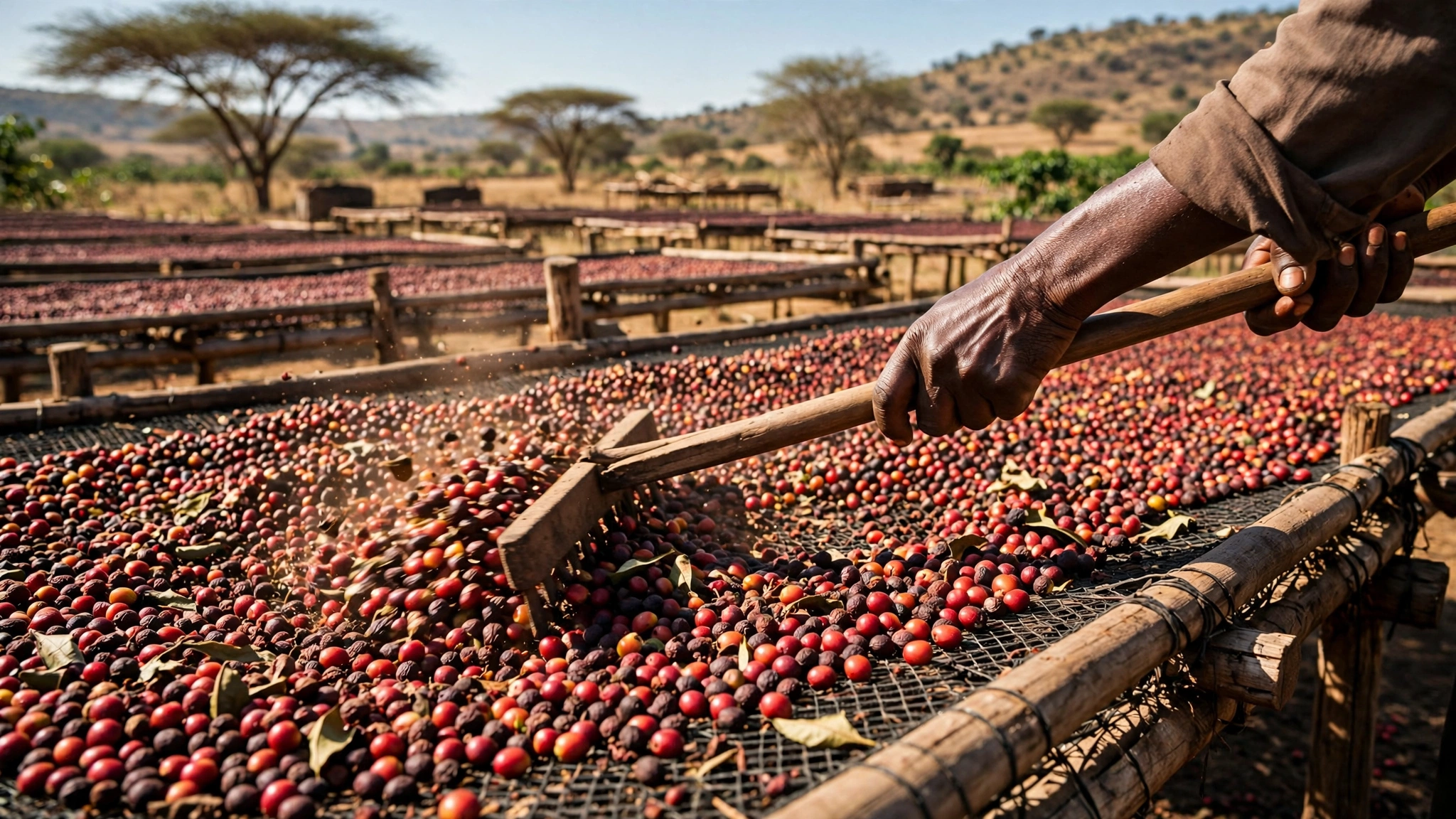
A coffee bean is the seed inside a fruit. Between the moment that fruit is picked and the moment the dried seed is ready for export, producers make a series of decisions about how to remove the fruit and how to dry the seed. That stage, called processing, has a profound influence on flavor. For many specialty lots it is the single biggest lever on how the coffee tastes, sometimes more than variety or altitude.
The anatomy of a coffee cherry
From the outside in, a ripe coffee cherry has:
- Skin (exocarp), the outer layer.
- Pulp (mesocarp), a thin fleshy layer.
- Mucilage, a sticky, sugar-rich layer that clings to the seed.
- Parchment (endocarp), a papery shell around the seed.
- Silverskin, a thin membrane directly on the seed.
- The seed itself, usually two per cherry, which becomes the green coffee bean.
Every processing method is a different strategy for dealing with the pulp and mucilage and for bringing the seed down to a stable moisture level, generally around 10 to 12 percent, so it can be stored and shipped.
Washed (wet) processing
In the washed method, cherries are sorted, often by floating them in water to remove underripe or damaged fruit, and then run through a depulper that strips the skin and most of the pulp. The seeds, still coated in mucilage, are fermented in tanks, commonly for roughly 12 to 48 hours depending on temperature, altitude and the producer's practice. Microbes break down the mucilage, which is then washed away. The parchment-covered seeds are dried on raised beds, patios or in mechanical dryers.
What it tends to taste like: Because the fruit is removed before drying, the cup typically emphasizes the bean's own character, with clarity, brighter acidity and cleaner, more defined flavors. Washed coffees often show florals, citrus, stone fruit or tea-like notes depending on origin. Some Kenyan producers use a double-fermentation and soaking sequence that adds further cleanliness.
Trade-offs: It uses significant water, though modern eco-pulpers and recycling systems can reduce consumption considerably, and wastewater needs treatment to avoid polluting streams.
Natural (dry) processing
Natural processing is the oldest method. Whole cherries are dried with the fruit intact, usually spread on raised African-style beds or patios and raked regularly. Drying typically takes a few weeks, depending on weather, and the cherry must be turned often to prevent mold and uneven fermentation. Afterward the dried fruit is hulled off in one step.
What it tends to taste like: Prolonged contact with the fruit can contribute pronounced fruitiness, sweetness and heavier body, with notes such as strawberry, blueberry, tropical fruit or wine-like qualities. At their best, naturals are vivid and jammy.
Trade-offs: The method is riskier. Uneven drying, humid weather or poor sorting can create off-flavors described as fermented, boozy, sour or musty. Great naturals depend on selective picking, careful drying and consistent monitoring. This is why the quality spread among naturals is wider than among washed lots.
Honey and pulped natural
These methods sit between washed and natural. The skin and pulp are removed by a depulper, but some or all of the mucilage is left on the seed while it dries. Despite the name, no honey is added; the sticky mucilage is what gives the process its label.
In Costa Rica and several neighboring countries, producers use color names such as white, yellow, red and black honey. These generally indicate how much mucilage remains and how slowly the coffee is dried, often with shade or thicker layers for darker categories. Exact definitions vary between producers, so treat the labels as a rough scale rather than a standard. In Brazil, a similar approach is called pulped natural.
What it tends to taste like: Honey coffees often present as sweet and rounded, with moderate acidity and more body than washed lots, but cleaner than most naturals.
Wet-hulling
Used most notably in Indonesia, wet-hulling (giling basah) removes the parchment when the bean is still wet, often at around 30 to 35 percent moisture, and then dries the exposed green bean. The practice speeds up drying in humid climates. It is associated with the low acidity, heavy body and earthy, herbal or spicy character of many Sumatran coffees. Wet-hulled beans often have a deep blue-green color and can have a more irregular shape.
Experimental and anaerobic fermentation
Over the last decade or so, producers have increasingly manipulated fermentation to create distinct flavors. In anaerobic fermentation, whole cherries or depulped seeds are sealed in tanks with limited oxygen, sometimes with controlled temperature, for a set period. Techniques borrow from winemaking, including carbonic maceration. Some producers add inoculated yeasts or bacteria, or ferment alongside other fruit.
The results can be bold, with intense fruit, spice, cinnamon or boozy notes. They can also be polarizing: some drinkers find them confectionery or artificial, and over-fermentation can cause sourness, vinegar-like notes or a cloying finish. These methods are also less standardized, so when a bag lists "anaerobic natural" or "carbonic maceration", the label covers a wide range of actual practices. Look for roasters who describe the process in detail and be aware that terminology is still evolving.
How to taste the difference
The cleanest way to learn what processing does is to compare two lots that share as many other variables as possible: the same farm or washing station, same variety, similar roast, different processing. Some producers and roasters release a washed and a natural from the same source for exactly this purpose. Brew them with the same recipe, side by side, and compare:
- Clarity versus fruitiness. Washed lots tend to feel crisper and more transparent, naturals more expressive.
- Acidity. Washed acidity often reads as sharper and more defined, while natural acidity can feel rounder and fruitier.
- Body and sweetness. Honey and natural lots usually add perceived weight and sweetness.
- Finish. Look for cleanliness. A lingering sour, fermented or funky note is often a clue to a processing flaw.
Quality and sustainability considerations
Processing choices carry economic and environmental weight as well as flavor. Natural and honey methods need less water but demand more drying space and labor. Washing stations can offer smallholders shared infrastructure but require wastewater management. Specialty processing can also increase a lot's price, which does not always translate into more money for the farmer, so looking for roasters who share transparent information about pricing and relationships is worthwhile.
No method is inherently better. Washed, natural and honey each express different strengths, and the most reliable approach for a curious drinker is to taste across them, notice what you prefer, and let that guide your buying.
