
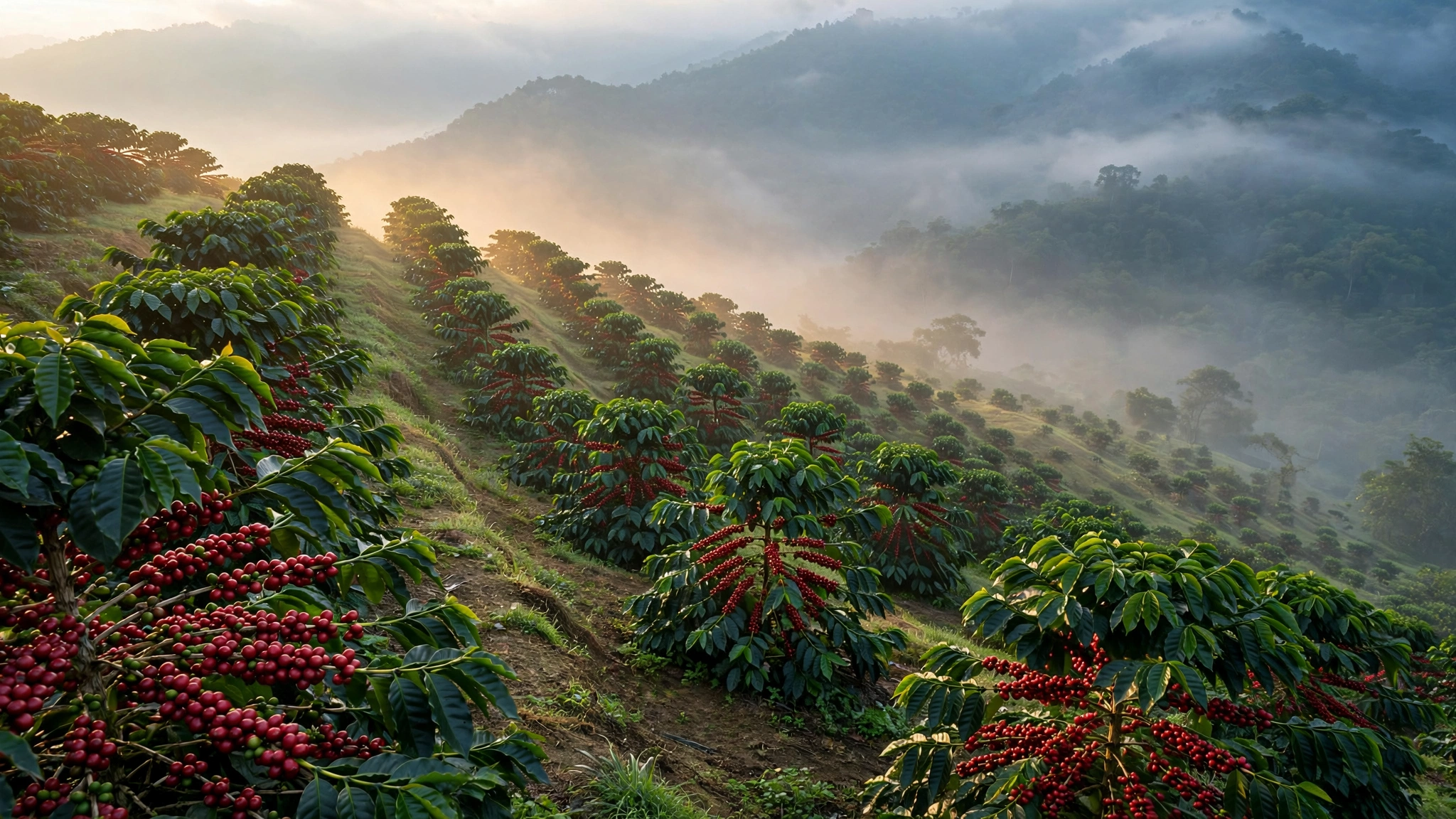
Coffee is grown in a belt around the equator, in more than fifty countries, and the label on a bag usually names one of them. "Kenya tastes like blackcurrant" and "Brazil tastes like chocolate" are the kind of shorthand enthusiasts trade constantly. There is real signal in those statements, and plenty of noise. This article separates the factors that genuinely shape a coffee at origin from the stereotypes layered on top of them.
What "origin" actually bundles together
A country name is a convenient label for several overlapping influences:
- Geography. Altitude, latitude, rainfall, temperature swings, soil and shade.
- Varieties. Which cultivars farmers plant, which depends on history, disease pressure and market demand.
- Processing tradition. Whether a region mostly washes, dries whole cherries or does something in between.
- Farm structure and infrastructure. Smallholders delivering to washing stations, large estates processing their own crop, or cooperatives pooling lots.
When someone says an origin tastes a certain way, they are often describing the combined effect of all four, and the processing tradition is frequently the biggest piece.
Altitude, climate and cherry development
Coffee at higher elevations generally ripens more slowly because temperatures are cooler. A longer maturation tends to produce denser beans with more developed sugars and organic acids, and many specialty buyers associate altitude with brighter acidity and more complexity. This is why many origins grade or price coffee by elevation, using terms like "strictly hard bean" (SHB) in parts of Central America.
The relationship is not linear and not universal. Latitude matters: near the equator, as in Colombia or Kenya, coffee can thrive at high elevation, while farther from the equator the same altitude is cooler and may be too cold. Diurnal temperature range, shade trees, soil composition and rainfall timing all play a part. Altitude is a useful indicator, not a quality guarantee.
Climate change is reshaping this picture. Rising temperatures push suitable land uphill, raise disease and pest pressure, and make rainfall less predictable. Farmers and researchers are responding with new varieties, shade management and in some places relocation of plantings, but the impact is uneven across regions.
A regional tour, with caveats
What follows are tendencies that reflect broad patterns in specialty coffee. Individual farms and lots routinely break them.
Ethiopia
Often called the birthplace of Arabica, Ethiopia hosts enormous genetic diversity in its forest and garden coffees. Regions such as Yirgacheffe, Sidama and Guji are known for floral, citrus and tea-like washed coffees, and for fruit-forward natural-processed lots with berry and tropical notes. Many smallholders deliver cherries to communal washing stations, and the coffee is typically sold under regional or station names rather than varieties.
Kenya
Kenyan coffee is associated with pronounced, juicy acidity and flavors often described as blackcurrant, tomato-like savory notes or citrus. Contributing factors include the SL28 and SL34 varieties, high altitude, red volcanic soils in many areas, and a classic washed process with soaking steps. Much of the crop is graded by bean size, with letter grades such as AA, and sold through auctions or direct relationships.
Colombia
Colombia's mountains create a wide variety of microclimates, so generalizations are risky. Huila, Nariño, Cauca and Tolima produce distinctly different coffees, from sweet and caramel-forward to bright and floral. Many producers are smallholders, and in some regions two harvests per year allow fresh crop to be available across more of the calendar. Colombia is mostly a washed-coffee country, though experimental processing is growing quickly.
Brazil
The largest coffee producer in the world, Brazil grows a significant share of the global crop, from mechanized estates on relatively flat terrain to smaller farms in the mountains of Minas Gerais. Naturals and pulped naturals dominate, and many Brazilian coffees lean toward chocolate, nut, caramel and low to moderate acidity, which is why they are a common base for espresso blends. Specialty Brazilian lots can be far more complex than that shorthand suggests, particularly from higher-altitude farms.
Central America
Guatemala, Costa Rica, El Salvador, Honduras, Nicaragua and Panama share a reputation for clean, balanced washed coffees, with regional differences. Guatemala's highland areas such as Huehuetenango and Antigua produce coffees ranging from fruity to cocoa-toned. Costa Rica has been a pioneer in honey processing and micro-mill production, where small farms process and sell their own lots. Panama is globally known for Geisha. Honduras and Nicaragua have grown rapidly in specialty quality in recent decades.
East and Central Africa beyond Kenya
Rwanda and Burundi, grown largely by smallholders delivering to washing stations, often yield coffees with sweetness, citrus and floral notes. Quality there has benefited from investment in washing-station infrastructure, though challenges around potato taste defect in Rwanda and Burundi are well documented.
Indonesia and the wet-hulled tradition
Sumatra is known for deep, earthy, herbal and sometimes spicy cups with heavy body and low acidity. A significant part of that character comes from the local wet-hulling method (giling basah), in which parchment is removed while the bean is still quite moist. Other Indonesian islands, including Sulawesi, Java and Flores, offer their own variations.
Terminology on a label: what the words mean
- Single origin. From one country or region. It is a broad term, as a country can contain many different coffees.
- Single estate or farm lot. Traceable to one farm, sometimes to a specific plot.
- Cooperative or station lot. Pooled from several smallholders, usually with a washing-station or co-op name.
- Blend. A deliberate combination, often used to achieve consistency or a house profile. A blend is not inherently lower quality.
Using origin knowledge well
Regional tendencies are best used as a map for exploring, not a test to pass. If you like bright, tea-like coffees, Ethiopian washed lots are a reasonable place to look. If you prefer sweet, low-acid cups, many Brazilian and some Central American coffees are a good bet. Then let your own tastes correct the generalization. Pay attention to the processing method, harvest date and roast level on each bag too, because those often explain a surprising cup better than the country does.
Finally, remember that freshness of the crop matters. Green coffee changes over time, and most is best consumed within a year of harvest. A bag that lists a harvest year or season gives you more information than origin alone.
