
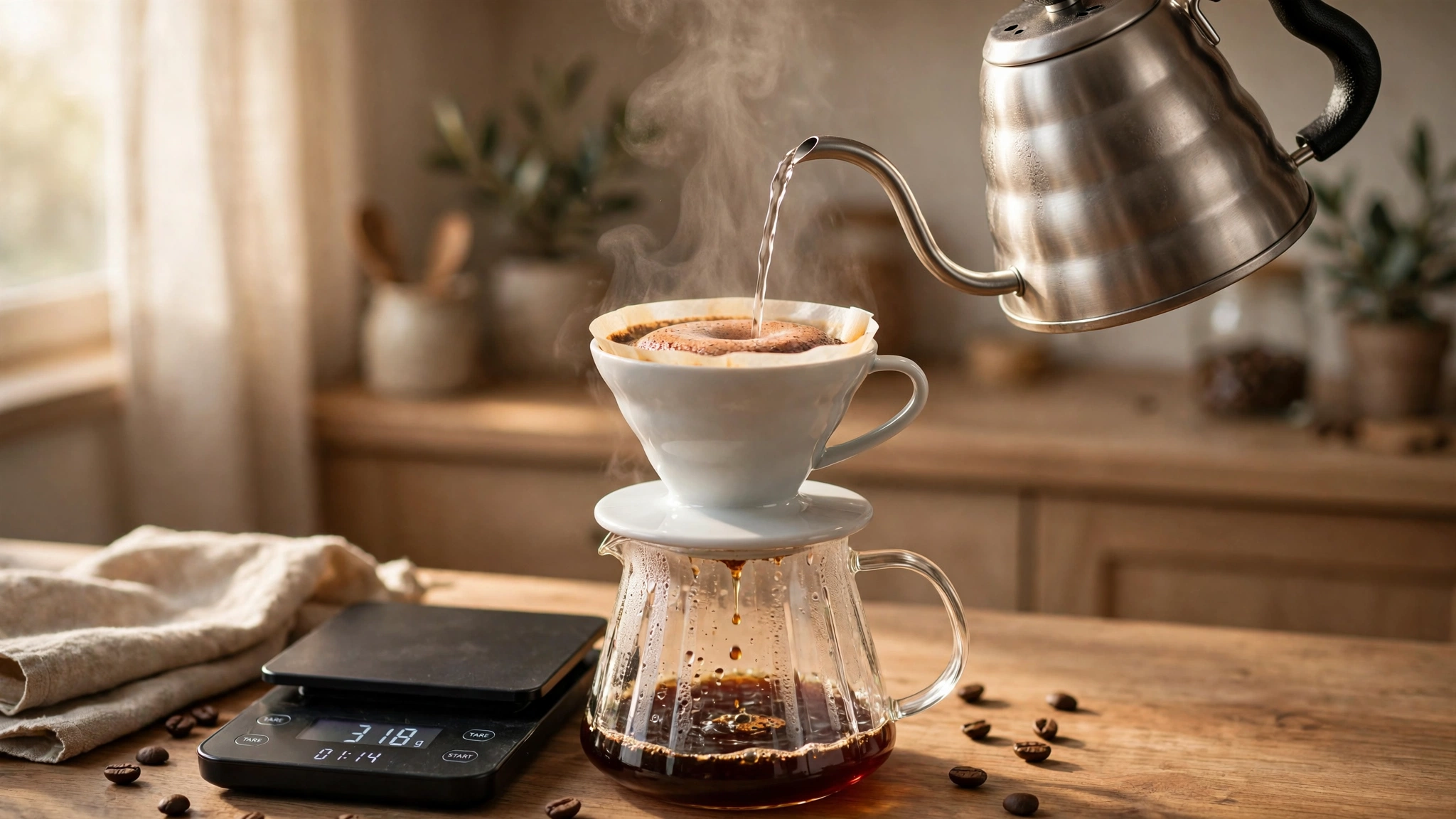
Every brewing method, from a V60 to an espresso machine, does the same job: dissolve some of the coffee's soluble material into water and leave the rest behind. The craft is in choosing which parts dissolve. Once the underlying principles are clear, individual recipes become starting points rather than commandments, and fixing a disappointing cup becomes a matter of reasoning rather than guessing.
Extraction and strength are different things
Two measurements describe a brew:
- Extraction yield is the percentage of the dry coffee grounds' mass that ended up dissolved in the cup.
- Strength, typically expressed as TDS (total dissolved solids), is the concentration of dissolved material in the liquid, such as roughly 1.3 percent for filter coffee.
You can have a strong, under-extracted brew (lots of coffee, little of each grain dissolved) or a weak, over-extracted one (little coffee, dissolved too long). The Specialty Coffee Association's long-standing "golden cup" guidance targets extraction yields of roughly 18 to 22 percent and filter-brew strength in the neighborhood of 1.15 to 1.35 percent TDS. Many enthusiasts brew outside those ranges on purpose, and for some coffees and roast levels higher or lower extractions taste better. Think of them as a reference zone rather than a rule.
The reason extraction matters is that different compounds dissolve at different rates. Acids and some fruity aromatics tend to come out earlier, sugars and sweetness in the middle, and heavier, more bitter and astringent compounds later. Stopping early tends to taste sour and thin; going on too long tastes bitter, dry or hollow.
The five variables you can control
1. Ratio (dose to water)
The ratio sets strength. Filter coffee commonly lands between about 1:15 and 1:17 coffee to water by weight, so 20 grams of coffee with 320 grams of water is 1:16. Espresso uses much more coffee relative to water, often around 1:2 for the liquid output, such as 18 grams in and 36 grams out. Use a scale: volume measures are unreliable because bean density varies with roast and origin.
2. Grind size
Grind controls surface area and flow resistance. Finer grounds dissolve faster and slow the water down; coarser grounds do the opposite. Grind distribution matters as much as the setting: a grinder that produces a wide range of particle sizes extracts the fines too much and the boulders too little, muddying the flavor. Burr grinders, which crush beans between two surfaces to a more consistent size, are generally preferred over blade grinders for this reason.
3. Water temperature
Hotter water extracts faster. Most filter brewing falls between about 90 and 96°C (194 to 205°F). Lighter roasts, which are denser and harder to extract, often benefit from the hotter end, while darker roasts, which extract readily, can taste better a few degrees cooler.
4. Time
Contact time is the total duration grounds spend in the water. In immersion brewing (French press, cupping, the AeroPress when steeped) it is the steep time. In percolation (pour-over) it depends on the pour structure and the resistance of the coffee bed, which is determined in part by grind size.
5. Agitation
Stirring, swirling and the force of the pour increase extraction and can influence evenness. A gentle approach and a rigorous one can produce meaningfully different results with the same recipe.
Water is most of your coffee
A cup is typically 98 to 99 percent water, so its mineral content has a major influence. Two mineral qualities matter most:
- Hardness (mostly calcium and magnesium) helps extract flavor compounds. Very soft water, such as distilled, often produces flat, underwhelming coffee.
- Alkalinity (buffering capacity, largely from bicarbonate) neutralizes acidity. Highly alkaline water can mute brightness and make coffee taste chalky, while too little alkalinity can make a cup taste sharp.
The SCA's water standard suggests total hardness in roughly the 50 to 175 ppm range, with a target around 68 ppm, and alkalinity near 40 ppm, with a neutral pH around 7. If your tap water is very hard or has a strong chlorine taste, a simple carbon filter or a bottled water with moderate mineral content is a sensible experiment. Water recipes designed for coffee exist, but they are not necessary to start.
Immersion versus percolation
Immersion methods (French press, cupping, Clever Dripper) keep grounds and water together for the entire brew. They are forgiving because extraction slows as the water saturates with dissolved material, and they tend to produce a rounder, heavier cup. Percolation methods (V60, Kalita Wave, Chemex, espresso) pass fresh water continuously through the grounds, which can produce brighter, cleaner flavors but gives you more variables to manage. Hybrid methods such as the AeroPress and some pour-over devices combine both approaches.
Starting points by method
The following are conventional starting recipes, not tested results. Treat them as launching pads and adjust to your beans and taste.
| Method | Typical ratio | Grind | Rough brew time |
|---|---|---|---|
| Pour-over (V60, Kalita, Chemex) | 1:15 to 1:17 | Medium-fine to medium | 2:30 to 4:00 |
| French press | 1:14 to 1:16 | Coarse | 4:00 to 8:00 steep |
| AeroPress | 1:12 to 1:16 | Medium to medium-fine | 1:30 to 3:00 |
| Espresso | About 1:2 (liquid out) | Fine | 25 to 35 seconds |
Pour-over technique
Begin with a "bloom": pour roughly twice the coffee's weight in water, wait about 30 to 45 seconds so trapped carbon dioxide can escape and the bed can wet evenly, then pour the rest in one or several stages. Fewer, steadier pours are easier to repeat. Rinsing paper filters first removes papery flavors and preheats the brewer.
French press and metal filters
Metal filters let oils and fine particles into the cup, which adds body. Unfiltered coffee also carries diterpenes such as cafestol, which can raise LDL cholesterol in regular heavy drinkers, so people with relevant health concerns often favor paper filtration. Check with a health professional for personal guidance.
Espresso
Espresso adds pressure, typically around 9 bars, to force water through a compact puck, and it is the least forgiving method. Uneven distribution and tamping can cause channeling, where water takes the path of least resistance and extracts unevenly. Dialing in means adjusting the grind to hit a target ratio and time, then tasting and adjusting.
Troubleshooting by taste
| If the cup tastes... | It may be | Try |
|---|---|---|
| Sour, thin, salty, lacking sweetness | Under-extracted | Grind finer, raise water temperature, extend contact time, or stir or pour more actively |
| Bitter, dry, hollow, astringent | Over-extracted | Grind coarser, lower temperature, shorten contact time |
| Weak but not sour | Too little coffee | Use a tighter ratio, such as 1:15 rather than 1:17 |
| Strong and harsh | Too much coffee or uneven extraction | Widen the ratio, check grind consistency and pour evenness |
Change one variable at a time and taste the result. If a coffee tastes unpleasant across several recipes, the problem may be the beans, their age, or the roast rather than the brew.
Consistency habits that pay off
- Weigh beans and water every time.
- Grind just before brewing, since ground coffee loses aroma quickly.
- Keep a short log of ratio, grind setting, temperature, time and impressions.
- Use the same water source, or note when it changes.
- Clean equipment regularly, as old oils turn rancid and add bitterness.
The aim is not a perfect number but a brew that tastes the way you want it to, and the ability to adjust when it does not.
